

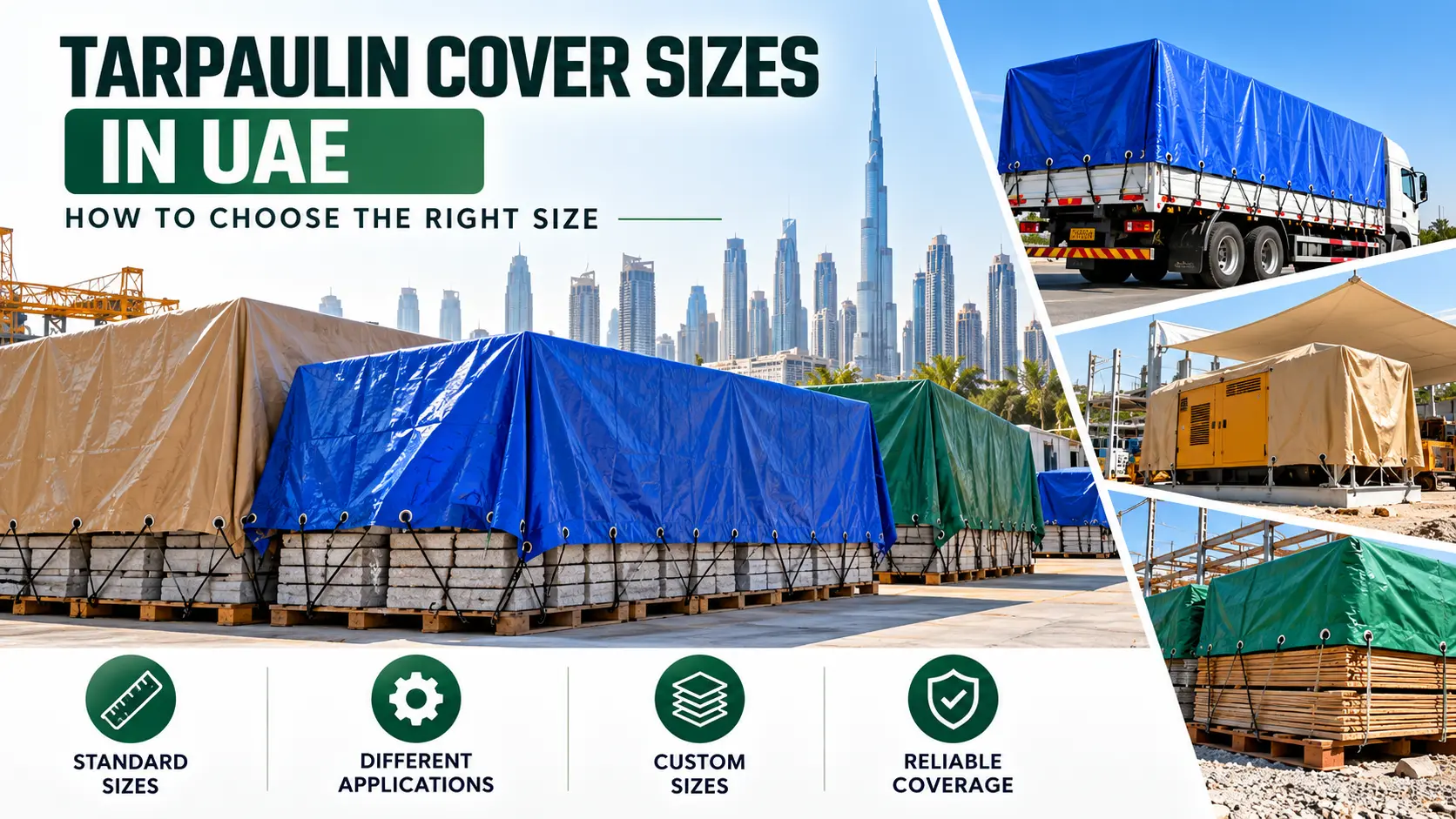
Choosing the right tarpaulin cover size is important when you need reliable protection for construction materials, machinery, vehicles, equipment, outdoor storage, or other exposed items. A cover that is too small may leave areas unprotected, while an unnecessarily large cover can be difficult to secure and handle.
For specialized applications, you can also explore our customized tarpaulin covers in UAEF for made-to-measure protection.
In the UAE, where outdoor covers can be exposed to strong sunlight, dust, heat, wind and occasional rain, selecting the correct dimensions is an important part of getting the right performance from a tarpaulin.
This guide explains common tarpaulin cover sizes, how to measure the required area, how much additional coverage to allow, and when a custom-sized tarpaulin may be the better option.
What Are Tarpaulin Cover Sizes?
Tarpaulin cover size generally refers to the length and width of the sheet or finished cover.
For example, a tarpaulin may be described as:
- 3 m × 4 m
- 4 m × 6 m
- 5 m × 7 m
- 6 m × 8 m
- 8 m × 10 m
- 10 m × 12 m
The appropriate size depends on what needs to be covered and how the tarpaulin will be installed.
A flat sheet used to cover a stack of materials may require different dimensions from a fitted cover designed for machinery, a truck, or outdoor equipment.
It is also important to distinguish between the nominal sheet size and the actual coverage required. Seams, hems, folds, attachment points and the shape of the object can affect the final dimensions needed.
For a broader overview of tarpaulin applications, materials and customization options, see our guide to tarpaulin covers in UAE.
Common Tarpaulin Sizes for Different Applications
There is no single standard size that works for every application. The right dimensions depend mainly on the object being covered and the amount of overlap required.
| Tarpaulin Size | Suitable Applications |
| 3 m × 4 m | Small equipment, materials and temporary covers |
| 4 m × 6 m | Construction materials, small machinery and storage |
| 5 m × 7 m | Larger equipment and outdoor storage |
| 6 m × 8 m | Machinery, material stacks and larger work areas |
| 8 m × 10 m | Large equipment, construction and commercial applications |
| 10 m × 12 m | Large storage areas, industrial equipment and extensive coverage |
These are useful reference dimensions rather than a universal sizing chart. The actual requirement should be calculated from the object or area being covered.
For larger or unusual applications, custom tarpaulin sizes can be produced according to the required dimensions and finishing specifications. HP Tarp states that it provides customized sizes and designs for applications such as truck covers, machinery enclosures, temporary shelters and construction-related covers.
How to Measure for the Right Tarpaulin Cover Size
Before ordering a tarpaulin, measure the area that needs protection rather than choosing a size based only on the name of the application.
Step 1: Measure the Length
Measure the longest side of the object or area you want to cover.
If the cover needs to extend over the ends, include the additional coverage required on both sides.
Step 2: Measure the Width
Measure the full width of the item or area.
For objects with height, remember that the cover may need to go over the top and down the sides, so a simple length × width calculation may not be sufficient.
Step 3: Account for Height
For boxes, machinery, material piles or other three-dimensional objects, include the height in your calculation.
For example, if you are covering a rectangular object, the required cover dimensions may need to account for:
Length + side drop + side drop
and
Width + end drop + end drop
This gives you a better estimate of the actual sheet dimensions required.
Step 4: Add an Allowance for Securing
A tarpaulin normally needs additional material around the edges so that it can be secured properly.
Depending on the application, the edges may be folded, reinforced or fitted with eyelets/grommets for tying and fastening.
This means that ordering a sheet with exactly the same dimensions as the object is not always the best approach.
How Much Extra Coverage Should You Allow?
The amount of extra material required depends on the application and how the cover will be secured.
For a simple flat cover, only a moderate amount of additional material may be needed around the perimeter.
For a three-dimensional object, however, the cover needs enough material to extend down the sides and provide room for fastening.
Consider the following:
- Required side drop
- Required end drop
- Overlap between sections
- Edge reinforcement
- Eyelet or fastening positions
- Wind exposure
- Shape of the object
- Accessibility for installation and removal
Avoid adding excessive material simply to be safe. An oversized cover can become heavier, harder to fold and more difficult to secure.
The goal is to achieve adequate coverage with practical handling and secure fastening.
Choosing Tarpaulin Sizes for Construction Materials
Construction sites often require covers for cement bags, equipment, scaffolding materials, aggregates, tools and other exposed materials.
The required size depends on the dimensions and height of the material stack.
For example, a small stack may only require a medium-sized cover, while larger material piles may require a much larger sheet with sufficient side coverage.
For construction applications, consider:
- Size of the material stack
- Height of the stack
- Required side coverage
- Frequency of access
- Wind exposure
- Number of fastening points
- Whether the cover will be reused
A properly sized cover can make installation easier and reduce the likelihood of exposed sections.
Choosing Tarpaulin Sizes for Trucks and Trailers
Truck and trailer covers require more careful measurement because the cover must accommodate the dimensions and shape of the cargo area.
Before selecting a truck tarpaulin, measure:
- Overall cargo-bed length
- Cargo-bed width
- Side-wall height
- Front and rear dimensions
- Required overlap
- Existing fastening points
For transport applications, the cover should provide sufficient coverage without creating excessive loose material.
HP Tarp provides customized tarpaulin solutions for truck and trailer covers, among other applications.
For commercial fleets, custom dimensions can be particularly useful when vehicles have different body configurations.
For heavy-duty applications where durability and long-term outdoor protection are important, PVC tarpaulins in UAE can be considered based on the required application.
Tarpaulin Sizes for Machinery and Equipment
Machinery often has irregular shapes, which makes standard rectangular sheets less convenient.
For equipment covers, consider:
- Overall equipment length
- Width at the widest point
- Maximum height
- Protruding components
- Access points
- Control panels or openings
- Required clearance around the equipment
A custom cover can be designed around the equipment rather than forcing a standard sheet to fit an irregular shape.
HP Tarp also offers customized tarpaulin solutions for machinery and equipment enclosures.
Tarpaulin Sizes for Outdoor Storage
For outdoor storage, the required dimensions depend on whether you are covering:
- Individual equipment
- Pallets
- Material stacks
- Tools
- Agricultural supplies
- Temporary storage areas
- Industrial goods
For pallet or material storage, measure the entire footprint and height, then add enough material for the required side drop and fastening.
If multiple items are being covered together, also consider whether one large cover or several smaller covers would be easier to install and maintain.
Small vs Large Tarpaulin Covers
Choosing the largest available tarpaulin is not always the best solution.
Small Tarpaulin Covers
Smaller covers are generally easier to:
- Handle
- Fold
- Transport
- Install
- Remove
- Store
They can be suitable for individual equipment, small material stacks and temporary protection.
Large Tarpaulin Covers
Larger covers are useful when a single sheet needs to protect:
- Large machinery
- Multiple material stacks
- Commercial storage areas
- Construction areas
- Large equipment
- Vehicles or cargo
However, larger covers may require more people or suitable equipment for installation and may need additional fastening points.
The right choice is therefore based on coverage requirements rather than simply choosing the biggest size available.
When Should You Choose a Custom Tarpaulin Cover?
A custom-sized tarpaulin is worth considering when a standard size does not provide the required coverage.
Custom sizing can be useful for:
- Irregularly shaped equipment
- Large machinery
- Truck and trailer covers
- Special storage requirements
- Temporary structures
- Industrial applications
- Covers requiring specific fastening positions
- Large commercial projects
Custom tarpaulin solutions can also include different finishing requirements such as reinforced edges, eyelets, grommets and other application-specific features. HP Tarp lists customized sizes and finishing options among its tarpaulin solutions.
How UAE Conditions Affect Tarpaulin Size Selection
The UAE climate makes secure installation particularly important for outdoor tarpaulin covers.
Heat and UV exposure can affect outdoor materials over time, while wind and dust can place additional demands on the cover and its fastening system.
When selecting a size for an outdoor application, consider:
- Exposure to direct sunlight
- Wind conditions
- Dust and sand
- Rain protection requirements
- Frequency of installation and removal
- Available fastening points
- Weight and handling requirements
The material itself also matters. HP Tarp offers PE, PVC and canvas tarpaulins for different applications, with PVC options intended for heavier-duty and longer-term outdoor requirements.
Common Mistakes When Choosing Tarpaulin Cover Sizes
- Choosing the Exact Object Size
A cover usually needs additional material for side coverage and fastening.
- Ignoring the Object’s Height
For three-dimensional objects, length and width alone are not enough.
- Choosing an Oversized Cover
Too much excess material can make installation and securing unnecessarily difficult.
- Forgetting Fastening Requirements
Eyelets, ropes, straps or other fastening methods require suitable edge space.
- Not Considering Access
If the covered equipment needs frequent access, the cover should be practical to remove and reinstall.
- Using One Standard Size for Every Application
Different applications have different dimensional requirements. A truck cover, machinery cover and construction material cover should not automatically use the same sizing approach.
Size is only one part of choosing the right cover; the required material weight should also match the intended application, as explained in our guide on choosing the right tarpaulin GSM.
Tarpaulin Cover Size Selection Checklist
Before ordering, confirm the following:
- Length: What is the total length to be covered?
- Width: What is the maximum width?
- Height: Does the object require side or end coverage?
- Drop: How far should the cover extend down the sides?
- Overlap: Is additional material required?
- Fastening: Where will the cover be secured?
- Shape: Is the object rectangular or irregular?
- Usage: Temporary or long-term?
- Handling: Can the selected size be installed easily?
- Customisation: Would a made-to-measure cover provide a better fit?
Taking these measurements before ordering can help avoid purchasing a cover that is either too small or unnecessarily large.
Why Custom Sizing Can Be Better for Large Applications
For large commercial and industrial applications, accurate sizing can make a significant difference in how easily a tarpaulin can be installed and secured.
A custom cover can be designed according to the actual dimensions of the application rather than relying on a standard sheet.
This is particularly useful when the cover requires specific dimensions, reinforced edges, eyelets or other finishing options. HP Tarp offers customized tarpaulin solutions across different applications in the UAE.
Final Thoughts
Choosing the right tarpaulin cover size in UAE starts with accurate measurements and a clear understanding of how the cover will be used.
Instead of selecting a sheet based only on a standard dimension, consider the object’s length, width, height, required side coverage and fastening requirements. For irregular equipment, large structures or specialized applications, a custom-sized tarpaulin may provide a more practical fit.
Whether the requirement is for construction, transportation, equipment protection or outdoor storage, the right dimensions can make the cover easier to install, secure and maintain.
For applications requiring specific dimensions, HP Tarp provides customized tarpaulin solutions in the UAE based on the required size, application and finishing requirements.
Frequently Asked Questions
Q1. What are the common tarpaulin cover sizes?
Ans – Common tarpaulin sizes include dimensions such as 3 × 4 m, 4 × 6 m, 5 × 7 m, 6 × 8 m and larger sizes. The appropriate size depends on the application and required coverage.
Q2. How do I choose the right tarpaulin cover size?
Ans – Measure the length, width and height of the area or object being covered. Then allow additional material for side coverage, overlap and fastening.
Q3. Should a tarpaulin be bigger than the object?
Ans – Usually, yes. Additional material may be required for side drops, overlap and secure fastening. However, excessive extra material can make the cover difficult to handle.
Q4. Can I get a custom-size tarpaulin in UAE?
Ans – Yes. Custom-sized tarpaulins can be produced for applications such as machinery, trucks, equipment, construction and specialized outdoor covers.
Q5. What size tarpaulin do I need for construction materials?
Ans – The required size depends on the length, width and height of the material stack, along with the amount of side coverage and fastening space required.
Q6. Are large tarpaulin covers difficult to install?
Ans – Large covers can require additional handling and fastening, especially in exposed outdoor areas. The installation method should be considered when selecting the size.
Q7. Can tarpaulin covers be made for irregular shapes?
Ans – Yes. Custom tarpaulin covers can be designed for equipment and applications where a standard rectangular sheet would not provide an appropriate fit.
Q8. Does tarpaulin material affect the required size?
Ans – The application determines the required dimensions, while material selection affects factors such as weight, durability and handling. HP Tarp offers PE, PVC and canvas options for different requirements.