

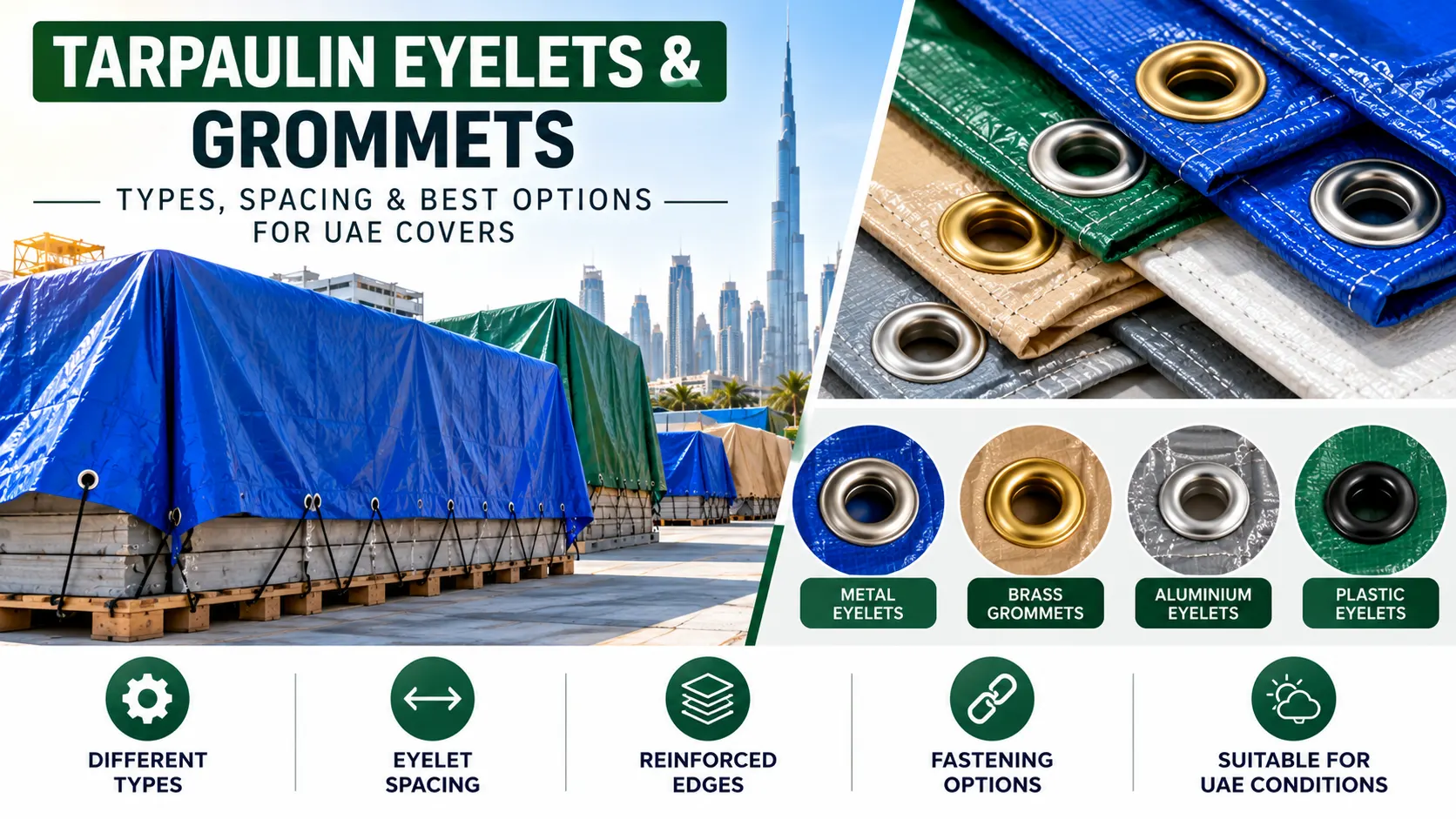
Tarpaulin covers are widely used across the UAE to protect construction materials, industrial equipment, vehicles, stored goods and outdoor spaces from sun, dust and rain. However, choosing the right tarpaulin material is only one part of creating a reliable cover. The eyelets, grommets, reinforced edges and fastening accessories also play an important role in keeping the cover securely in place.
Tarpaulin eyelets and grommets provide attachment points for ropes, hooks, bungee cords and other fixing accessories. Their material, size, positioning and supporting reinforcement can influence how well a cover handles regular use, tension and outdoor exposure.
Whether you need a lightweight cover for temporary storage or a heavy-duty PVC tarpaulin for industrial applications, understanding these fittings can help you select a suitable solution for your requirements.
What Are Tarpaulin Eyelets and Grommets?
Tarpaulin eyelets and grommets are fittings installed along the edges or at specific points on a tarpaulin sheet. They create openings through which ropes, cords, hooks or other fastening accessories can pass.
These fittings help users secure the cover to a supporting frame, tie-down point, vehicle, structure or stored object. They are especially useful when a tarpaulin needs to be removed, repositioned or secured repeatedly.
For example, a construction tarpaulin may use eyelets to attach the sheet to a temporary frame. A truck cover may require regularly positioned fastening points to help secure cargo protection during transport. Similarly, equipment covers may need customised fittings to match the shape and attachment points of the machinery.
The effectiveness of these fittings depends on more than the metal ring itself. The surrounding fabric, hem construction, reinforcement and fastening method must work together.
What Is the Difference Between Eyelets and Grommets?
The terms eyelet and grommet are often used interchangeably when discussing tarpaulin covers. Both refer to fittings that reinforce an opening and provide a point for attachment.
However, their exact construction can vary by manufacturer and application.
- Eyelets: Typically describe ring-shaped fittings installed through a prepared opening in the material.
- Grommets: Often refer to a fitting system that includes a ring and a backing component, such as a washer, to help hold the material around the opening.
- Reinforced eyelets: Eyelets installed through a strengthened section of the tarpaulin, which may include folded hems, extra fabric layers or webbing.
When comparing tarpaulin products, do not rely on terminology alone. Ask about the actual hardware, reinforcement method, material compatibility and intended application.
Common Types of Tarpaulin Eyelets
The most suitable eyelet depends on the cover’s material, exposure, frequency of use and fastening requirements.
- Metal Eyelets
Metal eyelets are commonly used for tarpaulin covers that require practical, reusable attachment points. They can accommodate ropes, hooks and compatible cords, depending on their internal diameter.
The appropriate metal depends on the application and expected exposure. For outdoor use in the UAE, consider corrosion resistance, heat exposure, contact with moisture and the maintenance requirements of the installation.
Metal eyelets may be suitable for construction covers, storage tarpaulins, vehicle covers and other applications where secure fastening is required.
- Brass Eyelets
Brass eyelets are an option for applications where corrosion resistance is an important consideration. Their suitability still depends on the grade, construction and conditions in which the cover will be used.
They may be considered for outdoor tarpaulins and covers that require repeated fastening. Confirm compatibility with the surrounding material and the expected tension before selecting them.
- Aluminium Eyelets
Aluminium eyelets offer a lightweight metal fitting option for certain tarpaulin products. Their suitability depends on the eyelet design, thickness, installation quality and loads expected during use.
Some tarpaulin specifications use aluminium eyelets at defined intervals along the edges. However, the spacing used for one product should not automatically be applied to every tarpaulin.
- Stainless Steel Eyelets
Stainless steel eyelets may be appropriate for specialised applications where corrosion resistance and durability are priorities. The correct grade should be selected according to the environment, including exposure to moisture, cleaning chemicals or coastal conditions.
They may be considered for demanding industrial or outdoor applications, provided the hardware and reinforced edge are designed for the intended use.
- Plastic Eyelets
Plastic eyelets may be used for selected lightweight or temporary covers. Their suitability depends on the plastic type, temperature tolerance, UV resistance and the tension applied during fastening.
For applications involving substantial pulling forces, frequent handling or prolonged outdoor exposure, compare the strength and durability of plastic fittings with suitable metal alternatives before making a decision.
Metal vs Plastic Eyelets: Which Should You Choose?
The right choice depends on how the tarpaulin will be used rather than simply on the fitting material.
| Consideration | Metal eyelets | Plastic eyelets |
| Typical applications | General outdoor and industrial covers | Selected lightweight or temporary covers |
| Load requirements | Depends on metal, design and reinforcement | Depends on plastic type and design |
| Corrosion | Depends on the metal and finish | Does not rust, but may degrade under UV or heat |
| Outdoor suitability | Depends on corrosion resistance and construction | Depends on UV and temperature resistance |
| Main selection factor | Strength, corrosion resistance and fit | Material quality, flexibility and exposure |
For a heavy-duty cover, choosing metal eyelets alone does not guarantee better performance. A well-designed reinforced edge and appropriate fastening arrangement are equally important.
How to Choose the Right Eyelets for Tarpaulin Covers
Before ordering a tarpaulin, consider the following factors.
- Identify the Application
Start by identifying what the cover needs to protect and how it will be secured. A temporary storage sheet may have different requirements from a truck cover, industrial equipment cover or large outdoor enclosure.
The application determines the expected tension, handling frequency and attachment layout.
- Check the Tarpaulin Material
PVC and PE tarpaulins have different material structures and fabrication requirements. The selected eyelets must be compatible with the material and its finished edge.
For PVC covers, ask whether the manufacturer can provide suitable hems, welded edges, reinforced corners and customised metal eyelets or grommets.
The cover’s material weight is another factor to consider, so read our guide to choosing the right tarpaulin GSM for different applications.
- Consider the Fastening Accessories
The eyelet’s internal opening must accommodate the intended rope, cord, hook or other fixing accessory. Check that the accessories can pass through easily without creating excessive friction or damaging the fitting.
- Evaluate Wind Exposure and Tension
Covers installed outdoors may experience changing tension due to wind and movement. If a cover will be exposed to strong gusts, its eyelets, edges, anchor points and fastening method should be selected as one system.
Simply adding more eyelets will not compensate for weak reinforcement or unsuitable anchoring.
- Check the Reinforcement
Look for securely finished hems and suitable reinforcement around attachment points. Large covers and frequently handled tarpaulins may require additional edge reinforcement or reinforced corners.
For customised applications, ask the supplier to confirm the recommended construction before production.
Tarpaulin Eyelet Spacing: What Should You Consider?
Tarpaulin eyelet spacing refers to the distance between neighbouring eyelets along the edge of a cover. It affects where the sheet can be attached and how tension is distributed around the perimeter.
There is no single spacing that is suitable for every tarpaulin. The correct arrangement depends on the material, finished dimensions, reinforcement, wind exposure, fastening method and available anchor points.
Before finalising the eyelet layout, start by choosing the right tarpaulin cover size and accounting for the required side coverage, edge finishing and fastening space.
Factors That Influence Eyelet Spacing
- Cover size: Large covers may require a carefully planned attachment layout to control loose sections.
- Wind exposure: Outdoor installations may need more closely coordinated attachment points and suitable anchoring.
- Material type: PVC, PE and other tarpaulin materials may require different reinforcement and fitting arrangements.
- Edge construction: A folded hem, welded edge, rope reinforcement or webbing can affect how loads are distributed.
- Fastening method: Ropes, elastic cords, straps and fixed hooks create different tension patterns.
- Installation layout: Eyelet positions should align with the actual hooks, rails, frame or other available anchor points.
Should Eyelets Be Installed at Fixed Intervals?
Not necessarily. Some ready-made tarpaulins have standard eyelet spacing, while custom covers can be manufactured to suit specific attachment requirements.
For example, HP Tarp lists a PE tarpaulin product with aluminium eyelets on all four sides at approximately 100 cm intervals, with a stated tolerance of ±5 cm. This is a product-specific specification, not a universal recommendation for all PE or PVC tarpaulins.
For customised covers, confirm the intended spacing and attachment positions with the supplier before production.
Can Eyelets Be Too Close Together?
Yes. Closely spaced holes may leave insufficient material between fittings or weaken a poorly designed edge. On the other hand, eyelets placed too far apart can leave unsupported sections and concentrate tension at individual attachment points.
The goal is to create a suitable layout that works with the cover’s reinforcement and the actual fastening arrangement.
Why Reinforced Edges Matter for Tarpaulin Eyelets
Eyelets are only as reliable as the material supporting them. When a rope or strap pulls on an eyelet, the force transfers into the surrounding fabric and the tarpaulin’s edge.
If that area is weak, the material may stretch, split or tear around the fitting even when the eyelet itself remains intact.
Reinforced edges help improve the support around these attachment points.
Folded or Welded Hems
A folded or welded hem creates a finished edge and may add material around the eyelet area. For suitable PVC tarpaulins, welding can be used to create a consistent edge construction.
Additional Reinforcement Layers
Extra material around the fitting can help distribute tension over a wider area. The reinforcement must be compatible with the main tarpaulin and appropriately secured.
Reinforced Corners
Corners often experience pulling from more than one direction when a cover is stretched over an object or secured diagonally. Additional corner reinforcement may therefore be appropriate for larger covers or demanding applications.
Rope or Webbing Reinforcement
A rope enclosed in the hem or webbing along the edge may be specified for certain covers. These options can support the fastening design, especially where repeated handling or particular tie-down arrangements are expected.
The exact reinforcement should be selected according to the intended application rather than added without considering the overall design.
Choosing Fastening Options: Ropes, Bungee Cords and Straps
Once the eyelets are selected, choose fastening accessories that fit the cover and its attachment points.
Ropes
Ropes are useful for tying covers to suitable frames, hooks and anchor points. Their diameter should fit through the eyelets without forcing or damaging them.
Bungee Cords
Elastic bungee cords can accommodate some movement and may be useful for temporary or frequently adjusted covers. Select cords designed for the required exposure and tension, and avoid excessive stretching.
Straps
Straps may be suitable for larger equipment covers, transport applications and installations requiring a specific tie-down arrangement. Ensure that the straps and anchor points are compatible with the tarpaulin’s reinforcement.
Hooks and Fixed Anchors
Hooks, rails and other fixed attachment points can help secure a cover where the installation has a defined structure. Their position should be considered when specifying eyelet placement.
Regardless of the accessory, avoid uneven tension or overtightening. A fastening system should secure the cover without placing unnecessary stress on individual eyelets.
Eyelets for PVC and PE Tarpaulins
Both PVC and PE tarpaulins can be manufactured with eyelets, but their construction and intended uses may differ.
When comparing PE tarpaulins in UAE, check the eyelet material, edge reinforcement and specified spacing to ensure they match your intended fastening arrangement.”
Why it fits: The destination discusses aluminium eyelets, reinforced corners, hems and customised eyelet spacing.
PVC Tarpaulin Eyelets
PVC tarpaulins are used for applications such as industrial equipment covers, storage protection, tents and selected transport requirements. Depending on the product specification, they can be fabricated with specialised grommets, eyelets, reinforced edges and customised fittings.
For a demanding application, discuss the material grade, edge finish, corner reinforcement and fixing layout with the manufacturer.
Explore PVC tarpaulin solutions in UAE to review available options.
PE Tarpaulin Eyelets
PE tarpaulins are used for a variety of covering and temporary protection requirements. Their eyelet configuration depends on the product design, material construction and intended fastening method.
When selecting a PE cover, check the stated eyelet material, spacing and reinforcement details rather than assuming that every product follows the same layout.
Common Eyelet Installation and Maintenance Mistakes
Avoiding a few common mistakes can help improve the performance and service life of a tarpaulin cover.
- Ignoring edge reinforcement: Installing eyelets in a weak edge can increase the risk of tearing around the holes.
- Choosing unsuitable spacing: A layout that does not match the anchors or expected tension may leave sections poorly secured.
- Using incompatible accessories: Ropes or hooks that do not fit the eyelets properly can cause wear or damage.
- Overtightening the cover: Excessive or uneven tension can place unnecessary stress on fittings and fabric.
- Ignoring corrosion or damage: Inspect metal fittings for corrosion, deformation, sharp edges or looseness.
- Leaving damaged eyelets unrepaired: A loose fitting or small tear may worsen if the cover continues to be used under tension.
- Neglecting the corners: Corners and other high-stress areas may need additional reinforcement, particularly on large or frequently handled covers.
Inspect the eyelets, hems, corners and fastening accessories periodically. If a fitting is damaged or the surrounding fabric begins to tear, repair or replace the affected section before continuing to use the cover in demanding conditions.
Choosing Tarpaulin Eyelets for UAE Conditions
The UAE’s outdoor environment can expose tarpaulin covers to intense sunlight, heat, dust and occasional strong winds. Covers used in coastal or industrial environments may also face additional exposure depending on the location.
When selecting eyelets and grommets, consider the complete installation:
- Choose hardware suitable for the intended environment.
- Confirm that the eyelets are compatible with the tarpaulin material.
- Specify suitable edge and corner reinforcement.
- Plan the eyelet layout around the actual anchor points.
- Use fastening accessories appropriate for the expected tension.
- Inspect the cover regularly, especially after severe weather or frequent handling.
For construction sites, warehouses, transport operations and industrial facilities, customised fittings may be preferable when standard eyelet positions do not match the required installation.
HP Tarp offers PVC tarpaulin options with customised eyelets, grommets and reinforcement according to customer requirements. Discuss your application and fixing arrangement with the supplier to determine a suitable specification.
Conclusion
Tarpaulin eyelets and grommets may appear to be small components, but they play an important role in securing a cover. Choosing the right fitting involves more than comparing metal and plastic options. The tarpaulin material, eyelet spacing, edge reinforcement, corner construction and fastening accessories must all suit the intended application.
For UAE conditions, prioritise a complete fixing system that matches the cover’s exposure, handling requirements and installation layout. When standard configurations are unsuitable, a customised tarpaulin with reinforced edges and appropriately positioned eyelets can help meet specific covering needs.
If you need a tarpaulin cover for construction, storage, transport or industrial use, explore HP Tarp’s PVC tarpaulin solutions and discuss the fittings and reinforcement required for your application.
Frequently Asked Questions
Q1. What are tarpaulin eyelets used for?
Ans – Tarpaulin eyelets provide reinforced attachment points for ropes, hooks, bungee cords and other fastening accessories. They help secure covers to suitable frames, anchor points, vehicles or stored objects.
Q2. Are eyelets and grommets the same?
Ans – The terms are often used interchangeably, although some manufacturers distinguish between a simple eyelet and a grommet assembly that includes a backing component. Check the actual fitting specification when ordering.
Q3. What is the best material for tarpaulin eyelets?
Ans – The best material depends on the application, exposure and fastening requirements. Metal options such as brass, aluminium or stainless steel may suit different conditions, while selected plastic eyelets may be suitable for lightweight applications.
Q4. What is the correct spacing for tarpaulin eyelets?
Ans – There is no universal spacing. It depends on the cover’s size, material, edge reinforcement, wind exposure, fastening method and anchor positions. Confirm the required layout with the manufacturer.
Q5. Do tarpaulin eyelets need reinforced edges?
Ans – Reinforcement is important when the cover will experience tension, repeated handling or demanding outdoor conditions. Hems, extra material layers, webbing and reinforced corners can help support the eyelets.
Q6. Can PVC tarpaulins be customised with eyelets and grommets?
Ans – Yes. PVC tarpaulins can be manufactured with customised eyelets, grommets, hems and reinforcement, depending on the product design and intended application.
Q7. Which fastening accessories can be used with tarpaulin eyelets?
Ans – Common options include ropes, bungee cords, straps and compatible hooks. The accessory should fit the eyelet and suit the expected tension and installation environment.
Q8. How can I prevent tarpaulin eyelets from tearing?
Ans – Use suitable reinforcement, select an appropriate eyelet layout, align fittings with anchor points and avoid excessive or uneven tension. Inspect the fittings and surrounding material regularly, and repair damage promptly.