

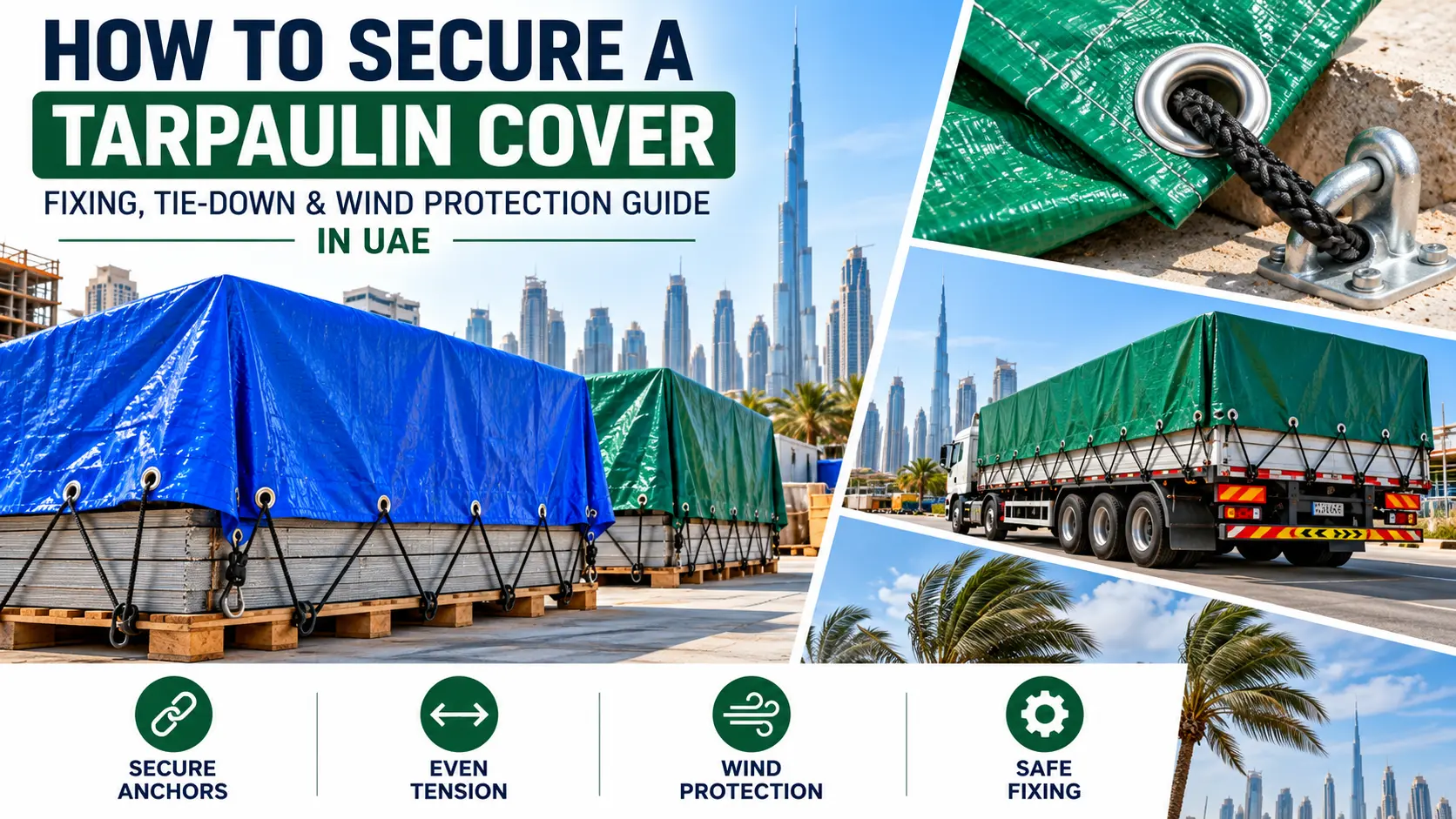
Securing a tarpaulin cover correctly is essential when protecting construction materials, machinery, vehicles, stored goods and outdoor equipment in the UAE. A poorly secured cover can loosen, flap in the wind, expose the items underneath or place excessive stress on its edges and fastening points.
The right fixing method depends on the tarpaulin material, the size of the covered object, the available anchor points and the conditions in which the cover will be used. Ropes, straps, bungee cords and reinforced eyelets can all help secure a tarpaulin when selected and installed correctly.
In the UAE, outdoor covers may experience intense sunlight, heat, dust and periods of strong wind. Therefore, choosing a suitable cover is only the first step. Proper positioning, balanced tension, reliable anchor points and regular inspections are equally important.
This guide explains how to secure a tarpaulin cover, choose appropriate tie-down methods and reduce common problems associated with outdoor installations.
Why Properly Securing a Tarpaulin Cover Matters
Tarpaulins are commonly used at construction sites, warehouses, transport facilities and commercial properties. However, even a durable cover may perform poorly if it is not installed correctly.
Proper fixing helps to:
- Keep construction materials and stored goods covered.
- Reduce excessive flapping and movement during windy conditions.
- Prevent avoidable stress on eyelets, hems and corners.
- Maintain coverage over machinery, equipment and other assets.
- Make the cover easier to inspect, remove and reinstall.
- Reduce the risk of the cover becoming detached and creating a hazard.
The objective is not simply to pull the cover as tightly as possible. Instead, the cover should fit the application, remain adequately supported and be secured without placing excessive force on individual fixing points.
Prepare the Tarpaulin Before Fixing It
Before installing a tarpaulin, check the cover and the area where it will be secured. A few preparation steps can help prevent installation problems.
- Choose the Correct Cover Size
The tarpaulin should provide sufficient coverage for the object, including any required side drops and fastening allowance. A cover that is too small may leave exposed areas, while an excessively large sheet can create loose sections that are difficult to manage.
For help calculating the required dimensions, read our guide on choosing the right tarpaulin cover size.
- Inspect the Cover and Its Edges
Check the tarpaulin for tears, worn sections, loose hems, damaged eyelets and weakened corners. Do not rely on a damaged attachment point to hold the cover under tension.
For demanding applications, look for suitable edge reinforcement and fittings compatible with the cover material.
- Identify Suitable Anchor Points
Decide where the ropes, straps or other fastening accessories will attach before positioning the cover. Anchor points should be stable, suitable for the expected loads and compatible with the application.
Avoid attaching a tarpaulin to weak fixtures, sharp edges or components that could move unexpectedly.
- Clear the Area
Remove sharp objects that could puncture the cover, and check for obstacles around the installation. If the cover is being installed over equipment or construction materials, ensure that the items underneath are stable and that the installation can be completed safely.
Best Ways to Secure a Tarpaulin Cover
Different fixing methods suit different applications. The following options are commonly used to secure tarpaulin covers.
- Secure the Cover Using Ropes
Ropes are a practical option for attaching tarpaulins to suitable anchor points, frames and structures.
To use ropes effectively:
- Position the cover evenly over the object.
- Pass the rope through compatible eyelets or designated attachment points.
- Connect it to suitable anchors without creating an uneven pulling force.
- Distribute tension around the cover rather than relying on one or two points.
- Check that the rope does not cut across sharp edges or damage the fabric.
The rope diameter and strength should suit the eyelets and the intended application. Knots and attachment arrangements should also be appropriate for the expected conditions.
Avoid pulling individual eyelets excessively hard. A strong rope cannot compensate for a weak hem or an unsuitable anchor.
- Use Straps for More Controlled Tie-Downs
Straps can be useful when securing larger covers, equipment or loads that have suitable attachment points. Depending on the design, they may provide a more controlled way to apply and adjust tension.
When using straps:
- Select straps appropriate for the application and expected load.
- Connect them to suitable anchor points.
- Keep the straps aligned to avoid unnecessary sideways pulling.
- Tighten them evenly without distorting the cover.
- Inspect buckles, hooks and webbing for wear before use.
Where a tarpaulin covers cargo on a vehicle, the cover and its tie-down system must be appropriate for transport. A tarpaulin should not be treated as a substitute for a properly designed cargo restraint system.
- Use Bungee Cords for Suitable Lightweight Applications
Bungee cords stretch to accommodate some movement and can be useful for selected temporary or lightweight covers.
They may be appropriate for garden equipment, temporary storage or covers that need to be removed frequently. However, elastic cords are not automatically suitable for every heavy-duty or high-wind installation.
Choose cords rated for the intended use, avoid excessive stretching and ensure that the hooks cannot detach unexpectedly. Do not rely on lightweight bungee cords as the primary restraint for heavy loads or demanding outdoor installations.
- Attach the Cover to a Suitable Frame
For applications involving a frame, shelter or supported structure, align the tarpaulin with the available attachment points.
The frame must be suitable for the loads it may experience. A large, tightly secured sheet can act like a sail in strong wind, transferring force to the frame and its anchors.
Use a fixing arrangement designed for the specific installation. Do not attach the cover to a structure simply because a convenient connection point is available.
How to Secure a Tarpaulin in High Winds
Wind protection requires attention to the entire installation, not just the fastening accessories. The size of the cover, its exposed surface area, the strength of its anchor points and the surrounding conditions all influence performance.
Reduce Loose and Flapping Sections
Loose material can flap repeatedly in the wind, increasing wear around the edges and attachment points.
Position the cover so it provides the required coverage without leaving unnecessary loose sections. Apply even tension and check that the edges are adequately supported.
However, do not overtighten the tarpaulin. Excessive tension can damage eyelets, tear fabric or overload the anchor points.
Distribute Tension Across the Cover
Avoid concentrating all the pulling force at a few corners. Use the available fixing points in a balanced arrangement so that tension is distributed around the cover.
The appropriate number and position of tie-downs depend on the cover design and installation requirements. There is no single arrangement suitable for every tarpaulin.
For more information about fittings and attachment points, read our guide to tarpaulin eyelets and grommets.
Check the Anchor Points
Even a well-secured tarpaulin can become unsafe if its anchor points loosen or fail. Inspect the supporting structure, hooks, ropes, straps and other fittings before use and periodically during service.
For installations exposed to strong winds, the anchoring system should be suitable for the expected conditions. If the structure or fixing points are not designed for the wind loads involved, stronger tightening alone will not solve the problem.
Avoid Unsafe Installation During Severe Weather
Do not attempt to install, adjust or remove a large tarpaulin during dangerous wind conditions. A loose sheet can move suddenly and become difficult to control.
If severe weather is forecast, follow the site’s safety procedures and the manufacturer’s guidance. Where a cover or structure appears unstable, keep people clear and seek qualified assistance.
Securing Tarpaulin Covers for Different Applications
The best fixing method varies according to what the cover protects.
Construction Materials and Equipment
Construction sites may use tarpaulins to protect building materials, tools, machinery and stored supplies from dust and weather exposure.
Choose a cover that provides adequate coverage, and secure it to suitable anchor points without placing excessive force on the material. Avoid allowing loose edges to interfere with access routes, machinery or work activities.
For scaffolding and large exposed structures, use a covering system specifically designed for that application. Large sheets can impose substantial wind loads on supporting structures, so professional assessment may be necessary.
Trucks and Transport Applications
Tarpaulins used over vehicles and cargo should fit the load and the vehicle’s designated attachment arrangement.
Check that the cover cannot loosen, obstruct the driver or interfere with vehicle components. Secure the cargo separately using suitable restraints, and inspect the cover before travelling.
During transport, wind exposure and vehicle movement can increase the demands on the fastening system. Use materials and fittings appropriate for the vehicle and its operating conditions.
Warehouse and Outdoor Storage
For stored equipment and goods, arrange the tarpaulin to provide the required protection while allowing practical access for inspection.
Use suitable anchor points and avoid sharp corners that could wear through the fabric. If the cover will remain outdoors for an extended period, inspect it regularly for damage, loosened fittings and signs of material deterioration.
Temporary Outdoor Covering
For temporary covering, prioritise easy access, secure attachment and safe removal. The cover should not obstruct walkways or create trip hazards with ropes and straps.
If conditions change, reassess the fixing arrangement rather than assuming that an installation suitable for calm weather will remain safe in stronger winds.
Choosing the Right Tarpaulin for Outdoor Conditions in UAE
The quality of the cover and its suitability for the application affect how reliably it can be secured.
PVC Tarpaulins
PVC tarpaulins are used for various industrial and outdoor covering applications. Depending on the product, they can be specified with reinforced edges, eyelets, hems and customised finishing options.
These features may help meet particular fixing requirements when the cover is designed and installed appropriately.
Explore PVC tarpaulin solutions in UAE to review options for different covering applications.
PE Tarpaulins
PE tarpaulins are used for many temporary covering and storage requirements. When choosing a PE cover, check its construction, edge finish, attachment points and suitability for the intended exposure.
Do not assume that every PE tarpaulin is suitable for prolonged exposure to strong winds or demanding industrial conditions.
Custom Tarpaulin Covers
A standard sheet may not suit an object with unusual dimensions, specialised attachment points or a complex shape.
Custom covers can be designed around specific measurements and finishing requirements. Depending on the application, this may include reinforced edges, selected eyelet positions and other compatible fittings.
The final specification should reflect the actual installation and the conditions the cover is expected to experience.
Common Tarpaulin Fixing Mistakes to Avoid
Avoid these common mistakes when securing a tarpaulin cover:
- Using an incorrectly sized cover: Insufficient coverage or excessive loose material can make installation more difficult.
- Relying on weak anchor points: A strong rope cannot prevent failure of an unsuitable fixing point.
- Applying uneven tension: Uneven pulling can concentrate force on individual eyelets and corners.
- Overtightening the cover: Excessive tension can damage the material, fittings or supporting structure.
- Using unsuitable accessories: Ropes, straps and bungee cords must be appropriate for the application.
- Ignoring damaged eyelets and hems: Worn attachment points may fail when placed under tension.
- Leaving sharp edges exposed: Contact with sharp surfaces can cut or abrade the tarpaulin.
- Skipping inspections: Wind, movement and repeated handling can loosen fittings or damage the cover over time.
Correcting these issues before installation is generally easier than dealing with a loose or damaged cover later.
How to Inspect and Maintain a Secured Tarpaulin
Regular inspection helps identify developing problems before they become more serious.
Check the following:
- Eyelets and grommets: Look for deformation, looseness, corrosion or tearing around the openings.
- Edges and corners: Check for split hems, worn reinforcement and frayed material.
- Ropes and straps: Look for cuts, fraying, damaged hooks or worn buckles.
- Anchor points: Confirm that the attachment points remain stable and suitable for use.
- Cover tension: Check for excessive slack, uneven pulling or material distortion.
- Surface condition: Inspect for punctures, abrasion and deterioration caused by outdoor exposure.
Inspection frequency should reflect the application, the amount of handling and the surrounding conditions. Covers exposed to changing weather or frequent movement may require more frequent checks.
If damage is found, remove the cover from service when necessary and arrange a suitable repair or replacement. Do not continue relying on a compromised fixing point for a demanding installation.
Conclusion
Knowing how to secure a tarpaulin cover involves more than tying ropes around its edges. The cover size, material, anchor points, fastening accessories and tension must all suit the intended application.
For outdoor use in the UAE, pay particular attention to wind exposure, edge reinforcement and the stability of the supporting structure. Distribute tension evenly, inspect the fittings regularly and avoid attempting installation or adjustments during dangerous weather.
If you need a tarpaulin for construction, storage, transport or industrial use, HP Tarp offers covering options for different applications. Discuss your requirements and the intended fixing arrangement to identify a suitable cover and finishing specification.
Frequently Asked Questions
Q1. How do you secure a tarpaulin cover properly?
Ans – Choose a suitable cover size, position it evenly, connect compatible ropes or straps to stable anchor points and distribute tension around the cover. Inspect the eyelets, edges and fittings before use.
Q2. How do I stop a tarpaulin from blowing away?
Ans – Use a suitable fastening arrangement, secure the cover to stable anchor points and reduce unnecessary loose sections. The fixing system must suit the cover size and expected wind conditions. Do not rely on lightweight cords or weak anchors for demanding installations.
Q3. What is the best way to tie down a tarpaulin?
Ans – Ropes, straps or other suitable fastening accessories may be used depending on the application. Select accessories that fit the attachment points, distribute tension evenly and avoid overloading individual eyelets.
Q4. Can bungee cords secure a tarpaulin in strong winds?
Ans – Bungee cords can suit some lightweight or temporary applications, but they are not appropriate as the primary restraint for every cover. For exposed or heavy-duty installations, use a fixing system designed for the expected conditions.
Q5. How tight should a tarpaulin cover be?
Ans – A tarpaulin should be secured evenly enough to limit unnecessary flapping without stretching the material excessively. Over-tightening can damage eyelets, hems, fabric and anchor points.
Q6. Which tarpaulin is suitable for outdoor use in UAE?
Ans – The appropriate choice depends on the application, duration of use, exposure and required protection. PVC and PE tarpaulins serve different needs; check the product specifications and ensure the fixing arrangement suits the installation.
Q7. How often should I inspect a secured tarpaulin?
Ans – Inspect the cover and its fittings before use and periodically during service. Increase inspection frequency where the cover experiences frequent handling, movement or changing weather conditions.
Q8. Can I secure a large tarpaulin cover myself?
Ans – Some small, manageable covers can be installed by an individual if the work is safe and the anchor points are suitable. Large covers, elevated installations and structures exposed to substantial wind loads may require trained installers and a professionally designed fixing system.