
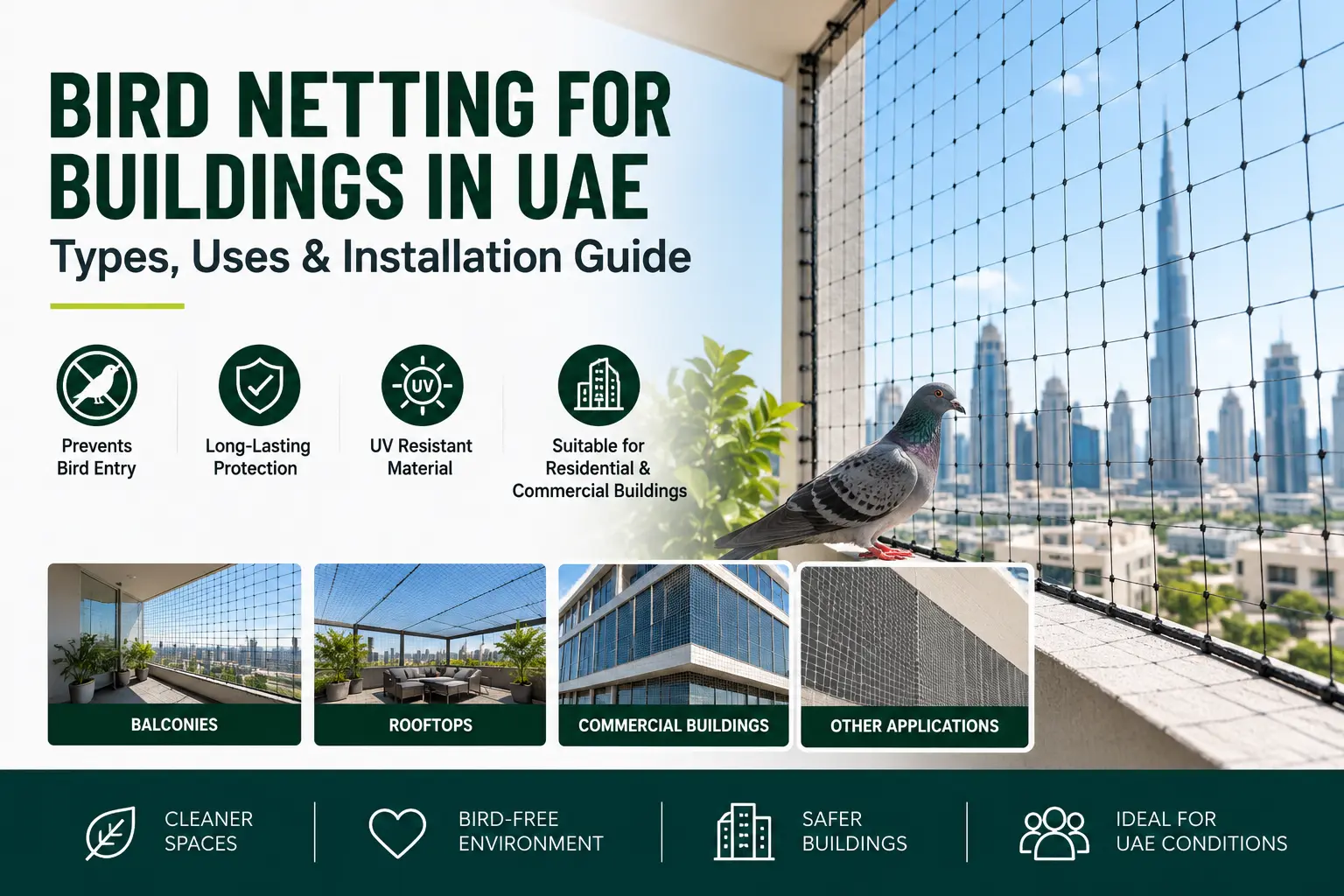
Birds and pigeons can become a recurring problem for residential, commercial, and industrial buildings in the UAE. Balconies, rooftops, service areas, warehouses, ventilation spaces, and other open sections can provide easy access for birds to nest and rest.
Over time, bird activity can result in droppings, unpleasant odours, nesting materials, surface staining, and additional cleaning requirements. In some locations, birds can also interfere with equipment or create hygiene concerns.
Bird netting for buildings in UAE provides a practical way to restrict bird access while keeping the protected area open and usable. The net creates a physical barrier across the required space without completely blocking ventilation or natural light.
However, choosing the right bird net involves more than simply selecting a mesh. The application, mesh size, material, UV resistance, installation method, dimensions, and expected exposure all need to be considered.
This guide explains the main types of bird netting, where they can be used, how installation works, and what to consider before choosing a bird netting solution for a UAE building.
What Is Bird Netting?
Bird netting is a lightweight mesh barrier designed to prevent birds from entering or occupying specific areas.
Unlike physical screens or solid barriers, bird netting can cover large openings while maintaining visibility and airflow. This makes it suitable for balconies, rooftops, courtyards, warehouses, building facades, and other open spaces.
Bird netting can be installed vertically or horizontally depending on the area that needs protection.
For example:
- A balcony may require vertical netting across the open side.
- A rooftop may require netting around specific open sections.
- A warehouse may need protection around loading or storage areas.
- A building service area may require netting across ventilation openings.
- A courtyard may require a larger enclosed netting structure.
The final configuration should always be selected according to the building layout and the bird problem being addressed.
Why Is Bird Netting Important for Buildings in UAE?
The UAE’s warm climate and dense urban environments can make bird control an ongoing consideration for building owners and facility managers.
Birds can access many areas of a building, particularly where open balconies, ledges, rooftops, or sheltered spaces are available.
A properly installed bird net can help:
Reduce Bird Entry
The primary purpose of bird netting is to create a physical barrier that prevents birds from entering protected areas.
Keep Areas Cleaner
Preventing birds from accessing balconies, rooftops, and service spaces can reduce the accumulation of droppings and nesting debris.
Protect Building Areas
Birds may repeatedly use the same locations for nesting or resting. Netting helps restrict access to these areas.
Maintain Ventilation
Unlike solid barriers, properly selected mesh allows air to move through the protected area.
Provide Long-Term Protection
A suitable outdoor bird net made from durable, UV-resistant material can provide continued protection when correctly installed and maintained.
Types of Bird Netting for Buildings
Different building applications may require different netting specifications. The most suitable option depends on the bird species, opening size, location, and installation requirements.
1. Balcony Bird Netting
Balconies are among the most common areas where bird netting is installed.
Open balconies can provide sheltered spaces for pigeons and other birds. Installing a suitable net across the open section creates a barrier while allowing the balcony to remain functional.
Balcony bird netting can be used for:
- Residential apartments
- Villas
- Hotels
- Office buildings
- Serviced apartments
- Commercial properties
The net should be properly tensioned and securely fixed around the perimeter to minimise gaps.
2. Rooftop Bird Netting
Rooftops can attract birds because they often provide elevated resting and nesting areas.
Bird netting can be installed across selected rooftop sections or around structures where birds regularly gather.
Typical applications include:
- Residential rooftops
- Commercial buildings
- Industrial facilities
- Utility areas
- Rooftop equipment zones
- Building service areas
The installation method should take into account the roof structure, access requirements, wind exposure, and maintenance needs.
3. Commercial Building Bird Netting
Large commercial properties may have multiple areas where birds can gain access.
Shopping centres, hotels, offices, warehouses, and other commercial buildings can use bird netting around open sections to reduce unwanted bird activity.
Large installations require careful measurement and proper tensioning because even a small opening can allow birds to enter the protected area.
4. Warehouse & Industrial Bird Netting
Warehouses and industrial facilities often have large entrances, loading areas, ventilation openings, and partially open structures.
Bird netting can help restrict access to selected areas while maintaining airflow.
It can be considered for:
- Warehouses
- Storage facilities
- Manufacturing units
- Loading zones
- Industrial sheds
- Service areas
For larger projects, the netting specification should be selected according to the size and environmental conditions of the installation.
What Material Is Used for Bird Netting?
Material selection is an important consideration when choosing bird netting for outdoor building applications.
High-quality bird nets are commonly manufactured using durable synthetic materials designed for outdoor exposure. HDPE (high-density polyethylene) is widely used for netting applications because it can provide a combination of strength, flexibility, and resistance to outdoor conditions.
For UAE applications, it is particularly important to consider UV stabilization because the net may remain exposed to intense sunlight for extended periods.
When comparing products, consider:
- Material quality
- Mesh construction
- UV resistance
- Tensile strength
- Flexibility
- Expected service life
- Installation environment
A reliable supplier can help determine which material specification is suitable for the building and application.
How to Choose the Right Bird Netting
Choosing the right bird netting starts with understanding the actual problem.
Identify the Bird Problem
Determine which birds are entering the area and where they are gaining access.
Pigeons may use balconies, ledges, rooftops, and sheltered corners, while other birds may require different protection requirements.
Measure the Area
Accurate measurements are essential.
Measure:
- Width
- Height
- Length
- Corners
- Openings
- Supporting structures
For irregular areas, a professional site measurement can help ensure better coverage.
Select Suitable Mesh
The mesh opening should be appropriate for the bird species that needs to be excluded.
A smaller bird may require a different mesh specification than a larger pigeon.
Consider UV Resistance
For outdoor installations in the UAE, UV-resistant material should be considered to improve the net’s ability to withstand prolonged sunlight exposure.
Check the Installation Method
The net must be properly secured around the perimeter.
Depending on the structure, installation may involve:
- Cables
- Hooks
- Clips
- Anchoring points
- Supporting frames
- Tensioning systems
The exact fixing method depends on the building and installation surface.
Bird Netting Installation Guide
Professional installation is important because even a high-quality net can perform poorly if it is incorrectly fitted.
Step 1: Inspect the Area
The installation area should first be inspected to identify access points, corners, obstacles, and suitable fixing locations.
Step 2: Take Accurate Measurements
Measure the entire opening that needs to be protected. Allow for the appropriate fixing and tensioning arrangement.
Step 3: Install the Support System
Cables, hooks, anchors, or other suitable fixing components are installed around the perimeter.
Step 4: Position the Net
The bird net is then positioned across the opening and attached to the supporting system.
Step 5: Tension the Net
The net should be properly tensioned so that it remains secure and does not leave unnecessary gaps.
Step 6: Inspect for Gaps
The completed installation should be checked carefully. Gaps around corners and edges can provide access for birds.
Step 7: Check the Finished Installation
Finally, the installation should be inspected to ensure that it provides appropriate coverage without unnecessarily interfering with doors, windows, ventilation, or building access.
Where Can Bird Netting Be Used?
Bird netting can be adapted to a wide range of building applications.
Residential Buildings
- Balconies
- Terraces
- Courtyards
- Service areas
- Rooftops
Commercial Buildings
- Hotels
- Offices
- Shopping centres
- Restaurants
- Commercial balconies
Industrial Buildings
- Warehouses
- Factories
- Storage facilities
- Loading areas
- Industrial sheds
Other Areas
- Parking structures
- Building entrances
- Open stairwells
- Utility spaces
- Large architectural openings
The best solution depends on the building design and the location where bird access occurs.
Benefits of Professional Bird Netting Solutions
A properly designed installation offers several practical benefits.
Effective Physical Barrier
The net directly restricts bird access to the protected area.
Low Visual Impact
Fine mesh can provide protection without creating the appearance of a heavy physical enclosure.
Maintains Airflow
The open mesh structure allows ventilation through the protected area.
Suitable for Large Areas
Bird netting can be adapted to balconies, rooftops, warehouses, and other large openings.
Customisable Installation
Netting can be cut and fitted according to the dimensions and configuration of the building.
Suitable for Outdoor UAE Conditions
When a UV-resistant and durable material is selected, bird netting can be suitable for prolonged outdoor exposure.
Common Bird Netting Installation Mistakes
Leaving Gaps Around the Edges
A small opening can undermine the effectiveness of the entire installation. Corners and perimeter sections should therefore be secured carefully.
Using the Wrong Mesh Size
Mesh should be selected according to the bird species and the intended application.
Poor Tensioning
Loose or sagging netting may reduce the effectiveness and appearance of the installation.
Ignoring the Building Structure
The fixing system should be compatible with the surface and structure where the net is being installed.
Choosing Material Based Only on Price
Outdoor installations need durable materials that can withstand environmental exposure. A cheaper product may not always provide the best long-term value.
Bird Netting vs Other Bird Control Methods
Bird netting is one option among several approaches to bird management.
| Solution | Main Purpose | Suitable For |
| Bird Netting | Physical exclusion | Balconies, rooftops, buildings |
| Spikes | Discourage landing | Ledges and narrow surfaces |
| Visual Deterrents | Discourage bird activity | Selected outdoor areas |
| Physical Screening | Restrict access | Openings and service areas |
For larger open spaces where birds need to be physically prevented from entering, netting can be particularly practical because it covers the complete opening.
For projects that require protection from excessive sunlight in addition to bird control, explore our shade net solutions in UAE for agricultural, commercial, and outdoor applications.
How to Maintain Bird Netting
Although bird netting generally requires limited maintenance, periodic inspection is recommended.
Check the installation for:
- Tears
- Loose fixing points
- Damaged cables
- Gaps
- Excessive sagging
- Accumulated debris
Outdoor installations should be inspected periodically, especially after severe weather or when the building is exposed to strong wind.
If damage is identified, repairs should be carried out promptly to maintain effective coverage.
For outdoor areas that also require protection from intense sunlight, explore our sun shade solutions designed for UAE conditions.
Why Choose HP Tarp for Bird Netting Solutions?
Choosing the right supplier is important when installing bird netting on a residential, commercial, or industrial property.
HP Tarp provides Bird Netting Solutions for different building and outdoor applications across the UAE. Our solutions can be considered for balconies, rooftops, commercial buildings, warehouses, and other areas where bird access needs to be restricted.
We focus on selecting suitable netting according to the application, dimensions, installation environment, and required level of protection.
For businesses and property owners looking for a reliable bird net supplier in UAE, professional guidance can make it easier to select the right material and installation approach.
Why Choose HP Tarp?
- Durable bird netting solutions
- Suitable options for residential and commercial applications
- Custom sizing
- UV-resistant material options
- Building and rooftop applications
- Professional installation guidance
- Solutions for different project requirements
For a dedicated overview of available products and applications, visit our Bird Nets page.
Explore our Bird Netting Solutions for residential, commercial, and industrial building applications across the UAE.
Conclusion
Bird netting provides a practical physical barrier for buildings where pigeons and other birds repeatedly enter balconies, rooftops, warehouses, service areas, and other open spaces.
The right solution depends on several factors, including the bird species, mesh size, material, UV resistance, building structure, dimensions, and installation method.
For UAE buildings, outdoor durability is particularly important. Selecting a quality net and securing it correctly can help provide long-term protection while maintaining ventilation and usability of the protected area.
Whether the requirement is for a residential balcony, commercial building, warehouse, or rooftop, a properly planned bird netting solution can help create a cleaner and more controlled environment.
Frequently Asked Questions
Q1. What is bird netting used for?
Ans – Bird netting is used to physically prevent birds from entering or occupying protected areas such as balconies, rooftops, warehouses, courtyards, and commercial buildings.
Q2. Is bird netting suitable for balconies?
Ans – Yes. Bird netting can be installed across open balconies to restrict bird entry while maintaining airflow and visibility.
Q3. What material is best for outdoor bird netting?
Ans – Durable synthetic materials such as HDPE are commonly used for outdoor bird netting. For UAE applications, UV-stabilized material should be considered because of prolonged sunlight exposure.
Q4. Can bird netting be installed on commercial buildings?
Ans – Yes. Bird netting can be used on hotels, offices, warehouses, shopping centres, industrial buildings, and other commercial properties depending on the building structure and application.
Q5. How long does bird netting last?
Ans – The service life depends on material quality, UV stabilization, installation quality, weather exposure, and maintenance. Regular inspection can help identify damage early and extend the useful life of the installation.
Q6. Does bird netting block airflow?
Ans – No. Because bird netting is made from open mesh, it generally allows airflow through the protected area while creating a physical barrier against birds.
Q7. Can bird netting be customized?
Ans – Yes. Bird netting can be cut and installed according to the dimensions and configuration of balconies, rooftops, warehouses, and other building openings.
Q8. Is professional installation necessary?
Ans – Professional installation is recommended for larger or complex areas because proper measurement, perimeter fixing, tensioning, and gap prevention are important for effective bird exclusion.